Would You Be My Palestine?

We can buy Almaza and get to your uncle’s place while he’s having his Argileh with his friends outdoors.

We can buy some of the Armenian nuts you like.

We can sit next to each other on the Sofa.

We can get nervous.

We can allow silence to be so loud.

This is it.

We can turn Valentine into a sacred sin.

Would you break the law with me?

We can wait till we finish our first bottle.

We can forget about your tomorrow and mine.

You can let me start right here and now.

Continue reading

Iraq's New Surge: Gay Killings

Excellent article on the killings of gays in Iraq written by Rasha Moumneh appeared yesterday on Foreign Policy:

Western attention has always focused primarily on sectarian attacks in Iraq. Yet al-Sadr’s militia and its counterparts in countless neighborhoods and towns have long had other targets in their cross hairs. These men claim to bear the banners of religion and morality, defending against any transgressors. They paint themselves as the caretakers of tradition, culture, and national authenticity — which often means keeping women, as well as men, in their rigidly enforced traditional roles. Ironically, they sell their violence as a means of security: Amid the total upheaval of Iraqi society over the last eight years, many people regard any relaxing of gender roles as a threat to public order, undermining patriarchal power. And since the coalition forces failed to provide security after the invasion, such cultural conservatives have moved in to fill the role. Many aimless, unemployed advocates of rigid traditionalism have taken up the task with their guns.

Continue reading

Arab Jews Against Zionism

Some Mizrahi are very blunt about the link between Zionism and their plight. “If Israel had not been established, nothing would’ve happened to the Iraqi Jews,” opines the Iraqi-Jewish poet Me’ir Basri.

But the suspicion and distrust did not end there. Their resemblance to Arabs – in fact, you could argue that they are also “Israeli Arabs” – in everything but religion caused them to be viewed with a mixture of condescension, contempt and even fear. This kind of culture shock is, at one level, understandable, as it is a myth to expect the simple fact of belonging to a single faith automatically means that people are the same. “We have here a people whose primitiveness sets a record,” wrote a Ha’aretz reporter in 1948, not of the Palestinians, but of Mizrahi refugees.

This anti-Mizrahi prejudice among the Ashkenazi elite (European Jews) translated into them being whisked away to live in the remotest parts of Israel and populate what are known as “development towns” that failed to develop into anything beyond a receptacle for broken promises and shattered dreams.

The Ashkenazi elite also set about “civilising” the Mizrahi Jews and shaping them into modern “Israelis”. Of course, to a certain extent, this happened to all immigrants, but since the Ashkenazi were calling the shots, it was their culture that most influenced the Israeli ideal.

Today, mizrahim still make up the bulk of Israel’s poor and undereducated; they are often stereotyped in the media as pimps, hustlers and whores; their culture is seen as somewhat inferior; and their accent, although it is the more accurate form of Hebrew, is scorned.

[...]

the Mizrahi experience resembles that of the Palestinians, and this is increasingly leading to joint activism at the grassroots level, such as when Israeli Arabs joined Mizrahi Jews protesting eviction in a village on the outskirts of Tel Aviv, even though it had once been a Palestinian village.

In addition, a vocal Mizrahi minority have been at the forefront of the peace movement for decades. For instance, it was a Mizrahi organisation, the radical Black Panthers, which was the first Israeli group to recognise the PLO, and a couple of years before the Madrid peace conference, Arab Jewish and Palestinian politicians, writers and academics held their own informal peace conference in the Spanish city of Toledo.

And even if it is misguided to believe that the chasm can be bridged, those who wish to work for peace and coexistence must continue to stretch as far across it as they can. As Sasson Somekh, the Iraqi-born professor of Arabic literature and long-time friend of the late Egyptian Nobel laureate Naguib Mahfouz, expressed it: “I am aware that I did not produce any important results, but I’m not going to stop.

(Thanks Marcy for the link).

"Curing" Lesbians by Raping Them

An article published on the Guardian on Thursday 12 March reveals that one of the leading football female players has been raped and stabbed 25 times for being a Lesbian:

The partially clothed body of Eudy Simelane, former star of South Africa’s acclaimed Banyana Banyana national female football squad, was found in a creek in a park in Kwa Thema, on the outskirts of Johannesburg. Simelane had been gang-raped and brutally beaten before being stabbed 25 times in the face, chest and legs. As well as being one of South Africa’s best-known female footballers, Simelane was a voracious equality rights campaigner and one of the first women to live openly as a lesbian in Kwa Thema… Human rights campaigners say it is characterised by what they call “corrective rape” committed by men behind the guise of trying to “cure” lesbians of their sexual orientation.

It is important to see that precisely because she’s open as a Lesbian and activist that she was subjected to this “corrective” criminal reaction in her society. Like in Lebanon, where gays and Lesbians have their NGOs, bars and night clubs mostly in Beirut and some are openly activists for their rights that we heard of two gay couple had been subjected to similar criminal reaction only this time by those who were supposed to protect the law.

Societies will never change if things kept in the secret, if things remain within the “political correct” constructed formula. While it is very difficult to be open as a gay person, it is very important to do so in order for societies to process this radical change in its structure even if by doing so you’ll be under serious attack.

In Syria there has been a sexual abuse by Shahabandar police station where police officers were harassing and mocking a transsexual person, male body with female sexual organs. They took off his clothes and touched him sexually and took pictures and videos of him. This harassment has been documented and videoed via cellphone that was distributed all over Damascus via bluetooth. My father who works in the Shahabandar area told me that the shops’ owners neighboring the police station heard a female voice shouting for help from within the station and hence they all went there to stop what they assumed to be a rape taking place. When the shop owners found out that the female voice was actually coming from a male voice with a female sexual organs they all disappeared and left the person alone facing abuse by the police just because he is neither a woman, nor a man, hence not a human being with equal rights that abusing him wouldn’t be exactly as abusing a woman, or man. Wondering if these incidents will ever take place in the Syrian streets, hmm..

There is something about these so called “protectors of law” and LGTB community. It is not a secret that the Tripoli police officers in Lebanon made arresting gays a hobby for them. No wonder why Anarchists hate the police so much ;-)

The Feminist Collective Project Launched!

I am proud of these inspiring Lebanese women who’ve put some great efforts to make this project happen. I’ve met some of the founders of this project in Beirut the past year, they’re good people and I have high hopes for this project.

One thing I dont like about their website, however, is that it’s mostly in English, and English is just not our region’s language and we cannot make a change adopting other people’s languages. After all, language is about communication, even though I think it’s much more than that, but I do not believe that any change could happen addressing the English-speaking people when they’re are, perhaps, more familiar with feminism. Unlike a blog, a project that has goals to achieve in a certain region needs to address the regional people in their very language. God knows that the very reason that I am hated by some Syrian bloggers who write in Arabic for my posts on LGTB were written in Arabic, not in English.

In other words, it’s easier to write in English about a topic that is far from familiar to the Arab world. Not to say that I think the west supports LGTB rights, I mean, in the west, they’re all about “free talking”.

But I am sure they’ll be working on this issue in the near future. Anyways, back to my sisters over here, check their core of values:

- Domestic migrant workers are employees and should have all the rights of employment, starting with respect and equality.

- We have a responsibilty to be smart consumers since what we buy and where we buy from are political as well as personal choices that effect us all.

Here is a list of things they believe that need to be changed:

- We are supposed to be smart and educated, but only to a certain extent.

- We are supposed to go out into the world, but only if we are chaperoned by a male family member.

- Throughout our lives, we have to prove that we are good daughters and then good wives and then mothers.

- We are supposed to want to be wives and mothers.

- We are all supposed to be strictly heterosexual.

- We are expected to look desirable but not act on our desires.

- We are expected to look good but not too good because then we’d be looking for attention, harassment, and even rape.

- Our family is supposed to be our protector, but a huge number of us are abused, physically and/or orally, inside our homes, by members of our families, and there are no laws to protect us from familial violence.

- In a country where more than half of the population are women, we have only 6 women parliament members, and only one minister is a woman.

- We are required to go from our parents’ house straight to our husband’s house.

- We’re not really Lebanese citizens, we’re just the daughters of Lebanese men. Because if we really did possess a Lebanese citizenship, we’d be able to pass our nationality to our husbands and children; but we can’t.

- And even though we are supposed to be equal in the eyes of the law, we are far, very far from being equal to men.

Their take on the argument that treats Arab feminist movements as westernized and imported:

Feminism is not an imported idea. Every time a woman stands up and refuses to be abused and exploited, every time she speaks up against her abusers, every time a woman believes in her capabilities and pursues her needs and ambitions, every time she resists being a victim or an object or an inferior being, she is being a feminist. And we don’t need any Western movement to teach us that — we’ve been doing it all along! And even though some of you may not call yourself a feminist, we’re sure you’ve been doing it too.

And finally, on Women’s international day, they’re going to hit the streets of Beirut, check their event on Facebook, their posts on their website, in EN and here in AR.
Queer activists call for boycott of Tel Aviv film festival

Via ei:

Queers Undermining Israeli Terrorism (QUIT!), a San Francisco Bay Area solidarity group, is calling on international Lesbian, Gay, Bi, Trans and Queer filmmakers not to participate in the Tel Aviv International LGBT Film Festival this June. QUIT!’s call for filmmakers to respect the cultural boycott of Israel initiated by more than 100 organizations of Palestinian civil society. The call has been joined by members of South West Asian and North African Bay Area Queers (SWANABAQ) and a founder of Trikone, the largest South Asian LGBT organization in the world.

One filmmaker has already notified festival organizers of his decision not to participate. Maher Sabry, director of the Egyptian film Toul Omry (All My Life), wrote: “It would be hypocrisy of me to call for boycotting the Egyptian government for mistreating gay men and not to call for boycotting Israel for the mass punishment of innocent Palestinian civilians for assault by few militants.” Sabry added, “One day, I dream to screen Toul Omry in the Holy Land, when it becomes a place of peace, when Jews, Christians, Muslims and others can live as equal with same rights, when there are no refugee camps, no religious or ethnic discrimination, no land-confiscation, tree-burning or house-demolition, no bloodshed and mass punishment, no injustice, no militants and no military aggression.”

The Palestinian Campaign for the Academic and Cultural Boycott of Israel was launched in Ramallah in April 2004 by a group of Palestinian academics and intellectuals to join the growing international boycott movement. International signatories include filmmakers Sophie Fiennes, Ken Loach, Haim Bresheeth and Jenny Morgan, writers John Berger, Arundhati Roy, Amiri Baraka, Naomi Klein and Eduardo Galeano, and musicians Brian Eno and Leon Rosselson.

In a letter to British director Shamim Sarif, whose film I Can’t Think Straight has already been accepted by the Tel Aviv festival, QUIT! stated, “As queer people, we know that mainstream media and organizations don’t tell the full story of our lives, and frequently present outright lies that once accepted become difficult to refute. One example of this practice is the conscious public relations campaign presenting Israel as the ‘only democracy in the Middle East,’ and specifically representing it as a haven for LGBT people … LGBT Palestinians living in the occupied territories, like straight Palestinians, are denied their basic human rights.”

Tinku Ishtiaq, a founder of Trikone and previous co-chair of the International Gay and Lesbian Human Rights Commission also wrote to Sharif: “Just as the international boycotts against South Africa during its apartheid era were helpful in finally bringing about the downfall of Apartheid it is hoped that similar boycotts against Israel would bring about the change that is necessary for Palestinians to survive … I believe that our rights should not supersede the rights of other oppressed groups. Your participation in the Tel Aviv film festival would be particularly sad for gay human rights activists who are struggling for Palestinian rights.”

QUIT! and its allies are asking international filmmakers to write to festival organizers notifying them that they will not submit their films or accept invitations to participate until Israel meets its obligations under international law. Israel is currently in violation of more than 80 United Nations resolutions, including Resolution 242, which affirms the right for the refugees to return home.

“Israeli queers are oppressed for their sexuality and gender identity, just as queers in every other country are,” said QUIT member Kate Raphael. “For the last several years their pride parades have been violently attacked by religious Jews. LGBT organizers in Israel should support the Palestinian boycott, which will lead to a more just society for everyone in the area. They should not ask international queers to break the boycott to participate in their event.”

QUIT! is a grassroots nonviolent direct action group based in San Francisco that has been active against war and occupation since early 2001.

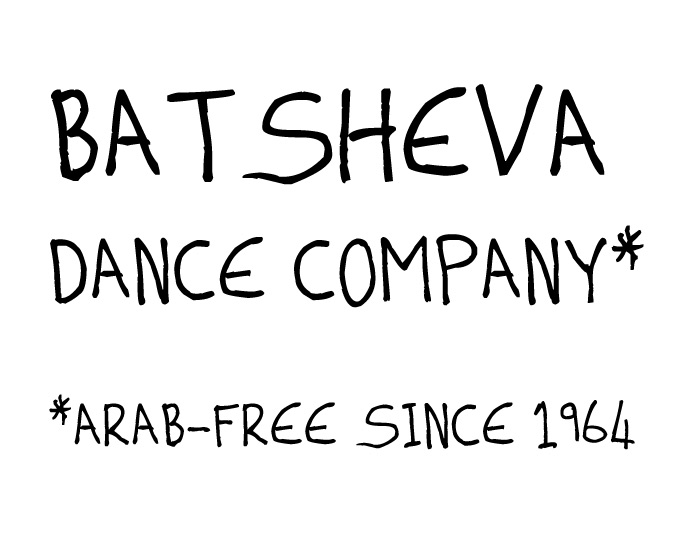
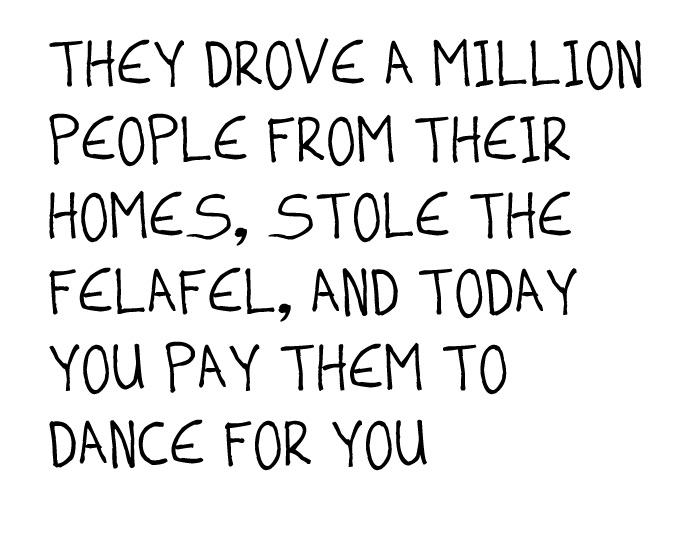
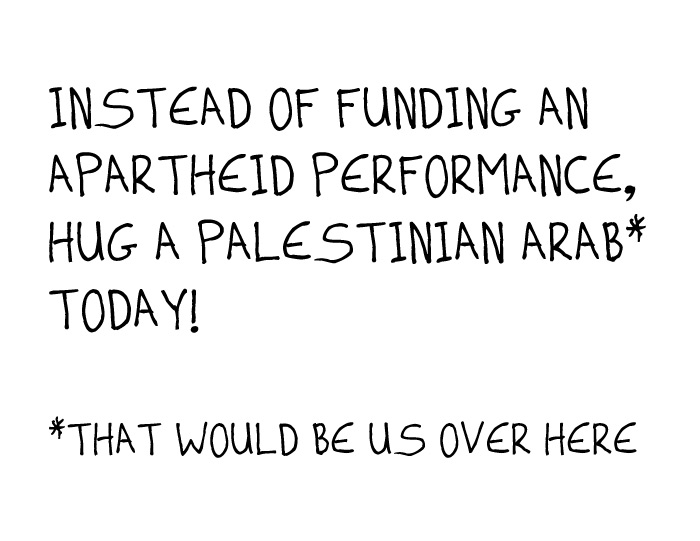
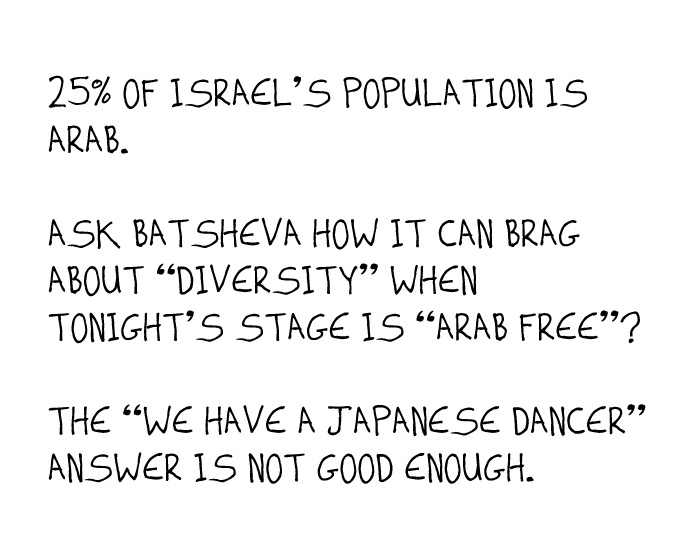
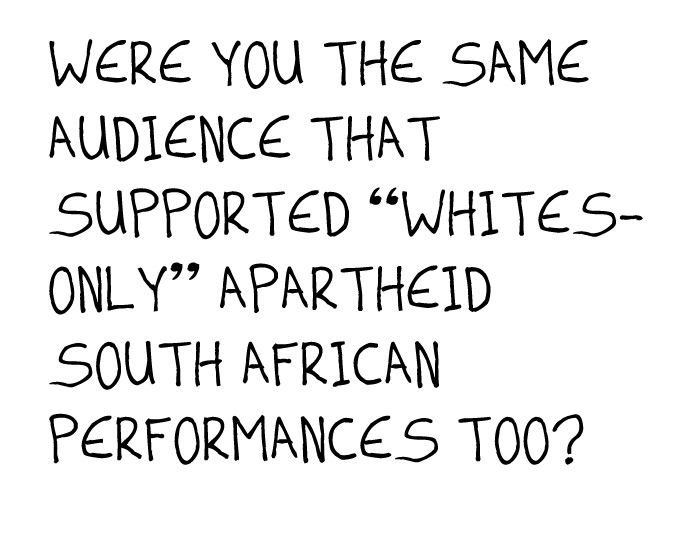
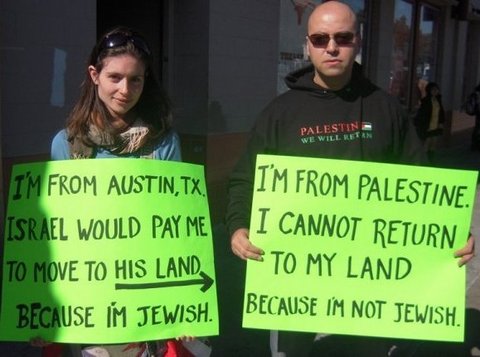
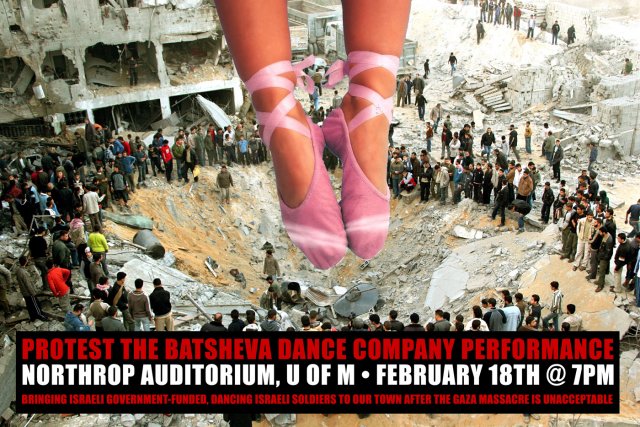
Protest signs for the Batsheva Dance Company tour of North America

From Nigel Parry blog:

The University of Minnesota is bringing the Batsheva Dance Company of Tel Aviv to Minneapolis [tonight] for one performance. This is a violation of the 2004 Palestinian call to “comprehensively and consistently boycott all Israeli academic and cultural institutions”and the 2005 call of 171 Palestinian civil society organizations for broad boycott, divestment and sanctions (BDS) against Israel. This dance company is funded by the Israeli government and is considered a “leading ambassador” of the Israeli government, by the Israeli government.

Several of Batsheva’s members are serving Israeli reservist soldiers. An atypically high number of reservist units in the Israeli army were deployed in the Gaza Strip-where an indisputable slaughter was carried out, with terrible stories published even in mainstream sources.

Bringing Israel government-funded, dancing Israeli soldiers to town after the gratuitous massacre of Gazans is utterly unacceptable.

Batsheva is described as “perhaps the best known global ambassador of Israeli culture” by the Israeli government and its self-description often includes the phrase that “Batsheva is proud to be considered Israel’s leading ambassador.” How does Batsheva reconcile its international mission as an artistic ambassador with the reality of the racist, militaristic, and expansionist state that it represents?

These flayers are made by Nigel Parry to help American activists in their protest to this Zionist company which is touring the US right now. check his post over here for more flayers.